

Artificial shoulder joint (shoulder prosthesis): types, procedure and modern treatment options
When is an artificial shoulder joint necessary?
If all conservative measures no longer help in cases of painful joint wear or serious injuries , an artificial shoulder joint (endoprosthesis) can significantly improve the quality of life .
The goal is to eliminate pain, maintain mobility, and enable patients to return to everyday life, work, and sports .
Typical reasons for an artificial shoulder joint are:
Osteoarthritis (joint wear)
Fractures of the humeral head or glenoid fossa
Severe cartilage damage
Rotator cuff defects in combination with osteoarthritis
What is an artificial shoulder joint?
An artificial shoulder joint (shoulder prosthesis) replaces worn or damaged joint surfaces with metal and plastic implants. It is used for osteoarthritis, fractures, or tendon ruptures when pain and restricted mobility can no longer be treated conservatively. The goal is to restore pain relief and mobility.
Modern technology: navigation and robotics
Computer-assisted implantation of shoulder prostheses is becoming increasingly important. Using customized CT data, navigation, and robotics, implants can be inserted more precisely .
Advantage: a precisely positioned implant exploits the full potential of the prosthesis and leads to better long-term results .

Types of shoulder prostheses
1. Hemiendoprosthesis (humeral head prosthesis)
If the humeral head is worn out or destroyed after a fracture, but the joint socket remains intact , replacing the humeral head is often sufficient.
Procedure: The surface of the humeral head is removed and replaced with a stemless prosthesis.
Advantage: Bone is largely preserved, no long shafts necessary.
Optional: Replacement of the pan if it is damaged.
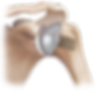
2. Anatomical total shoulder arthroplasty
If both the humeral head and the acetabulum are affected, a total hip replacement is used.
Short-stem prosthesis firmly anchored in the upper arm
Cup replacement mostly made of polyethylene, cemented or cementless
Cup types: keel or tenon anchorage, depending on bone quality
For special indications, there are titanium cups with a polyethylene attachment that can be implanted without cement and later converted into an inverse system.

3. Inverse shoulder prosthesis
In cases of extensive rotator cuff damage, a conventional prosthesis is not sufficient. In this case, a reverse prosthesis is used.
Principle: The ball sits on the socket, the socket on the upper arm – in other words “the other way around”.
Biomechanics: The center of rotation is shifted so that the deltoid muscle takes over the function of the damaged tendons.
Use: usually from the age of 65, when the rotator cuff is irreparable, but the deltoid muscle is intact.
Materials: What is a shoulder prosthesis made of?
Metal parts : titanium or cobalt-chromium alloys (stable, durable, biocompatible)
Sliding surfaces : Polyethylene, which serves as a joint surface
Options : cemented or cementless, depending on bone quality and patient age
Procedure of the operation
Preparation: anamnesis, diagnostics (MRI, CT), surgical planning, if necessary with navigation.
Surgery: Depending on the indication, arthroscopically assisted or open.
Implantation: precise placement of head and socket replacements.
Aftercare: Rest, physiotherapy exercises, gradual increase in load.

Rehabilitation after a shoulder prosthesis
Rehabilitation is crucial for the outcome:
Phase 1 (0–3 weeks): Immobilization, pain relief, passive movements.
Phase 2 (3–6 weeks): Increasing the range of motion, lymphatic drainage for swelling.
Phase 3 (6–12 weeks): Strengthening muscles, improving coordination.
Phase 4 (from 3–6 months): Sport-specific training, return to everyday life and work.
Risks and durability
As with all surgeries, there are risks such as infection, loosening, or wear of the prosthesis. However, thanks to modern materials and techniques, shoulder prostheses often last 15–20 years or more .

What should patients pay attention to?
Choosing an experienced shoulder specialist
Precise surgical planning with modern imaging
Consistent rehabilitation and aftercare
Regular medical check-ups
Conclusion: Artificial shoulder joint for a better quality of life
An artificial shoulder joint is a reliable option when pain and restricted mobility severely impact your life.
With modern prosthetics, computer-assisted navigation, and consistent rehabilitation, excellent results can be achieved – for a pain-free, mobile shoulder and an active life.
👉 Make an appointment now – we will advise you individually on your shoulder prosthesis.

FAQs about artificial shoulder joints
When do you need an artificial shoulder joint?
In cases of severe osteoarthritis, fractures or irreparable tendon damage.
What types are there?
With a reverse prosthesis, tendon healing is not as critical as with an anatomical prosthesis, but movements should still be practiced initially under the supervision of a physiotherapist to ensure smooth movement of the new joint. This is usually achieved after 3-4 weeks, so that with a reverse prosthesis, follow-up treatment can then begin. Overall, a follow-up period of 3-6 months should be expected after an artificial shoulder joint. Many patients experience improvements in their movement beyond the first year.
How long does a shoulder prosthesis last?
Usually 15–20 years, depending on load and bone quality.
This is what happens after an artificial shoulder joint.
After the procedure, the affected arm is supported in an orthosis. For the first few days, it's important to keep the arm in this position to prevent the new joint from dislocating. With an anatomical artificial joint, the rotator cuff is usually retained or reattached, which means the tendons need time to heal into the bone during the first six weeks. During this time, the arm should not be rotated too far outward.
How does the aftercare differ for inverse prostheses.
With a reverse prosthesis, tendon healing is not as crucial as with an anatomical prosthesis, but movements should still be practiced initially under the supervision of a physiotherapist to ensure smooth movement of the new joint. This is usually achieved after 3-4 weeks, so that with a reverse prosthesis, follow-up treatment can then begin. Overall, a follow-up period of 3-6 months should be expected after an artificial shoulder joint. Many patients experience improvements in their movement even beyond the first year.


PROF. DR. MED BEN OCKERT
Specialist in orthopedics and accident surgery, sports medicine.
